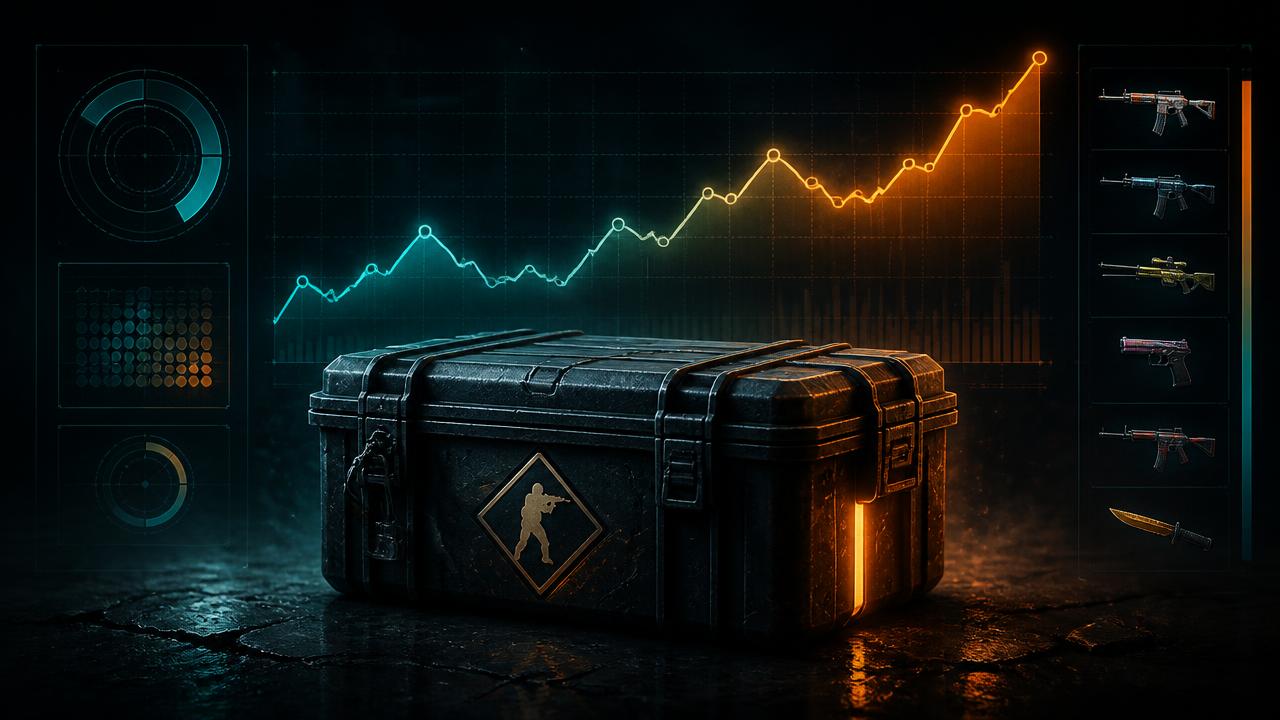

The CS2 skin economy had a brutal May. According to tracking from CSMarketCap and VPEsports, total market capitalization fell roughly 6% over a single week, dragging the global skin market cap down to approximately $4.50 billion — hundreds of millions of dollars in paper value wiped out in a few days. For anyone who funds a CS2 gambling account by depositing skins, this is the most important market move of 2026 so far, and it cleanly continues the slide we flagged in our Q2 2026 market update.
What Actually Happened in May
After the all-time-high quarter we covered in our Q1 piece, the market started rolling over in April and accelerated downward in May. Two specific events did most of the damage:
- A mid-May Valve item update that adjusted drop rates and introduced new cases. New supply almost always compresses prices on the existing case pool, and this update was unusually broad.
- Macro skin-liquidity stress. The NY AG lawsuit's progression toward Valve's motion to dismiss (covered in our Happy Meal Toys article) made larger holders more cautious. When the biggest wallets de-risk, the bid side of the market gets thin fast.
The drop wasn't uniform across the market. Knives and gloves — the most speculative high-end of the market — fell hardest, with several index baskets down 8–10% on the week. Rifles and stickers held up better. Cases themselves were essentially flat: low-priced, supply-driven, and tied to drop-rate mechanics rather than speculative demand.
Why This Is Different From Routine Volatility
Skin prices move around constantly — a 2–3% week is normal noise. A ~6% drop in seven days, concentrated at the high end and confirmed across multiple independent indexes (CSMarketCap, csskinlab, take.skin), is statistically a real move, not a tracking artifact. It's the second-largest weekly drop of 2026 and the largest since the post-Q1 cooling phase began.
The market is also visibly thinner. Daily traded value on the Steam Community Market and the larger third-party marketplaces (Skinport, CSFloat, DMarket) is down meaningfully week-on-week. Lower volume on the way down typically means the move isn't done — there's no real buyer flow stepping in to defend prices.
What It Means for Gambling Deposits
This is the part most CS2 gambling content skips, and it's the one that actually affects readers of this site. If you deposit skins on a gambling platform, the value of your deposit is set at the moment of deposit — and a falling market changes the math in two specific ways:
- Deposit ratios get worse on the way down. Many sites apply a "depo discount" relative to Steam Community Market or buff163 — typically 70–90% of reference price. When the reference price itself is sliding, the gap between what your skin is "worth" on Steam and what you actually get credited can feel larger than it really is. Always check the live ratio before you click.
- Withdrawal inventories shift. Operators rebalance their available withdrawal items based on market value. In a falling market, expect to see fewer high-tier knives and gloves available for withdrawal — they get pulled into operator treasury rather than offered out, because the operator doesn't want to hand out a depreciating asset at peak credit value.
The practical answer for a typical user is straightforward: in a clearly falling market, prefer crypto or fiat deposits over skin deposits where possible, and treat balance you've already deposited as "in play" rather than as a long-term hold. Our skin deposits guide walks through how the ratios work in detail.
Deposit Now or Wait?
The question every reader asks at this point: "should I deposit my skins now, or hold and wait for prices to recover?" Honest answer: nobody knows. But the framework that helps is this.
- If you intend to gamble with the value anyway, deposit now. The deposit price is locked the moment you complete the trade — you've effectively de-risked from further skin-market drops in exchange for site credit. The risk you take from that point is gambling variance, not market variance.
- If you're a holder who doesn't intend to gamble all of it, don't deposit. Skin deposits are not a clean round-trip; the spread between deposit and withdrawal credit means you'll always lose value crossing the gambling boundary twice. Hold the skins in Steam or a marketplace and only convert when you actually want to play.
- If you're sitting on knives or gloves specifically, the case for caution is strongest. These are the items that took the most damage in May and are the most exposed to the next Valve update. Smaller rifles and well-loved skins are far less reactive.
Q3 2026 Outlook
Three things to watch over the next 90 days, in rough order of impact:
- The NY lawsuit timeline. Any procedural milestone — ruling on Valve's motion to dismiss, additional state filings, settlement signals — will move the market. Expect a few percent of volatility around each.
- The next Major and its sticker capsules. Sticker drops historically lift the entire market for 4–8 weeks. The next confirmed Major will be the strongest tailwind on the calendar.
- Steam API and trade-bot changes. Anything that affects marketplace liquidity hits the third-party ecosystem first. We're already seeing pressure here, with the recent BitSkins shutdown as the most visible casualty.
The Takeaway
May 2026 was a real, broad-based pullback in the CS2 skin market — not a blip. Market cap is back to around $4.50B, the high-end of the market took most of the damage, and volume on the way down suggests the move isn't necessarily finished. For gamblers specifically, the right posture is to be a bit more deliberate about skin deposits this quarter: lock in deposit value if you plan to play, hold in Steam if you don't, and don't try to time the bottom on a market that's responding to litigation as much as to gameplay updates.