
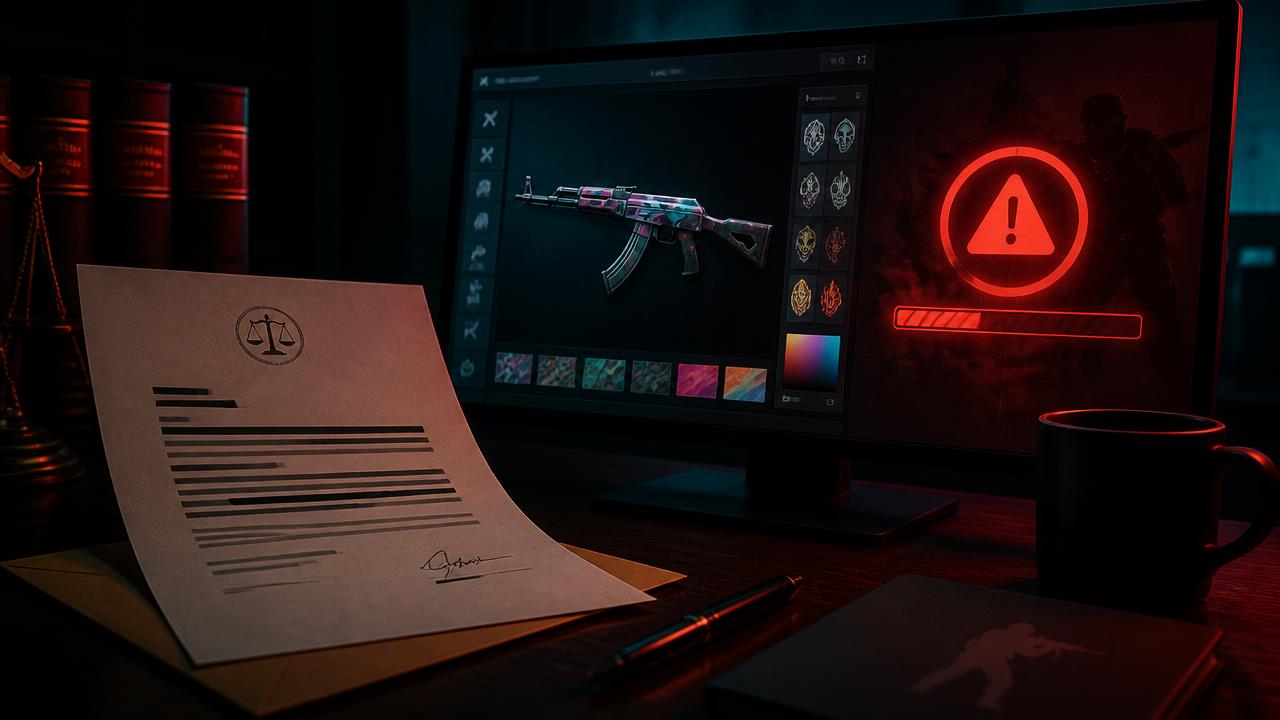
On September 11, 2026, Valve's legal team sent a cease-and-desist letter to one of the largest third-party CS2 skinchanger platforms in operation, demanding that it stop distributing its software and stop commercialising Counter-Strike assets. It is not a gambling case. No case site was named, no wagering law was invoked. But for anyone who runs — or plays on — a CS2 skin gambling site, it is worth reading carefully, because the legal logic Valve leaned on is the same logic that underpins every platform built on Steam inventories.
What Actually Happened
Skinchangers are client-side tools that make a player's weapons appear to carry skins they do not own. The cosmetics are fake and visible only locally, which is exactly why the category survived for years: nothing is transferred, nothing is sold on the Steam market, and the argument was always that no real item changed hands.
What changed is scale and money. The platform in question had grown into a commercial operation with paid tiers, a subscriber base and marketing that traded openly on Counter-Strike branding and Valve's own skin artwork. Valve's letter targeted that commercial layer — the use of its intellectual property to sell a product, and the distribution of software that modifies its game client in breach of the Steam Subscriber Agreement.
The response was near-immediate compliance. That is the normal outcome: a cease-and-desist is cheap for Valve to send and enormously expensive for a small operator to fight, particularly one whose entire revenue base depends on continued access to the game it is modifying.
Why This Matters to Skin Gambling Sites
Every CS2 gambling site that accepts skin deposits runs on infrastructure Valve controls and could withdraw. Trade bots, the Steam Web API, OpenID logins and the item economy itself are all Valve services offered under terms Valve writes. The industry's standing assumption has been that Valve tolerates skin gambling as long as it stays quiet, stays off tournament jerseys and does not damage the game's reputation.
The last twelve months have steadily narrowed that tolerance. The December 2025 licensing rules pushed skin gambling brands off sponsored events, and by mid-2026 that ban was visibly enforced at tier-1 tournaments — we covered that in our report on the sponsorship ban being enforced. The September cease-and-desist extends the same pattern to software: Valve is willing to act directly against commercial third parties that monetise Counter-Strike without permission.
The practical read: Valve does not need new legislation or a court ruling to change the skin gambling landscape. An API policy change, a trade-hold rule or a letter from its lawyers can do it in a week. That is a platform risk no licence protects you from.
The Legal Backdrop
Valve is already defending a stack of loot-box and skin-gambling litigation in the United States, and its consistent position in those cases is that it does not operate gambling and does not authorise third parties to do so. Acting visibly against unauthorised commercial use of CS2 assets reinforces that position. Each enforcement action makes it harder to argue that Valve knowingly permits an ecosystem to be built on its items.
Regulators are watching the same thing from the other direction. Several jurisdictions have moved on skin wagering in the past two years, and enforcement bodies increasingly treat the tradability of an in-game item as the thing that makes it gambling. If Valve ever restricted that tradability — as it has done before with trade holds and, for CS:GO keys, an outright market ban in 2019 — a large part of the skin deposit economy would have to convert to cash overnight.
What Players Should Take From It
Nothing about this action changes what you can do today. Skin deposits still work, trade bots still run, and the sites in our rankings are unaffected. The lesson is about where you leave value, not about whether to play at all.
- Do not store an inventory on a gambling site. Withdraw to Steam. Items sitting in a site balance depend on that site keeping Valve access.
- Prefer operators with a licence and a real company behind them. Our rating methodology weights licensing heavily for exactly this reason.
- Avoid third-party software entirely. Skinchangers, "free skin" tools and inventory boosters are the fastest route to a VAC ban or a phished account — see our scam avoidance guide.
- Treat platform risk as real. A site can be honest, solvent and still be cut off from the item economy by a decision it does not control.
The Bottom Line
One cease-and-desist against a cheat-adjacent platform is not the end of CS2 skin gambling. But it is another data point in a consistent 2026 trend: Valve is drawing firmer lines around commercial use of Counter-Strike, and it is enforcing them. The operators that will still be here in two years are the ones building on licensed, cash-capable infrastructure rather than assuming the skin economy is a permanent fixture.
Details of the letter come from the receiving platform's own public statement and subsequent community reporting; Valve has not issued a public comment. We will update this article if it does.