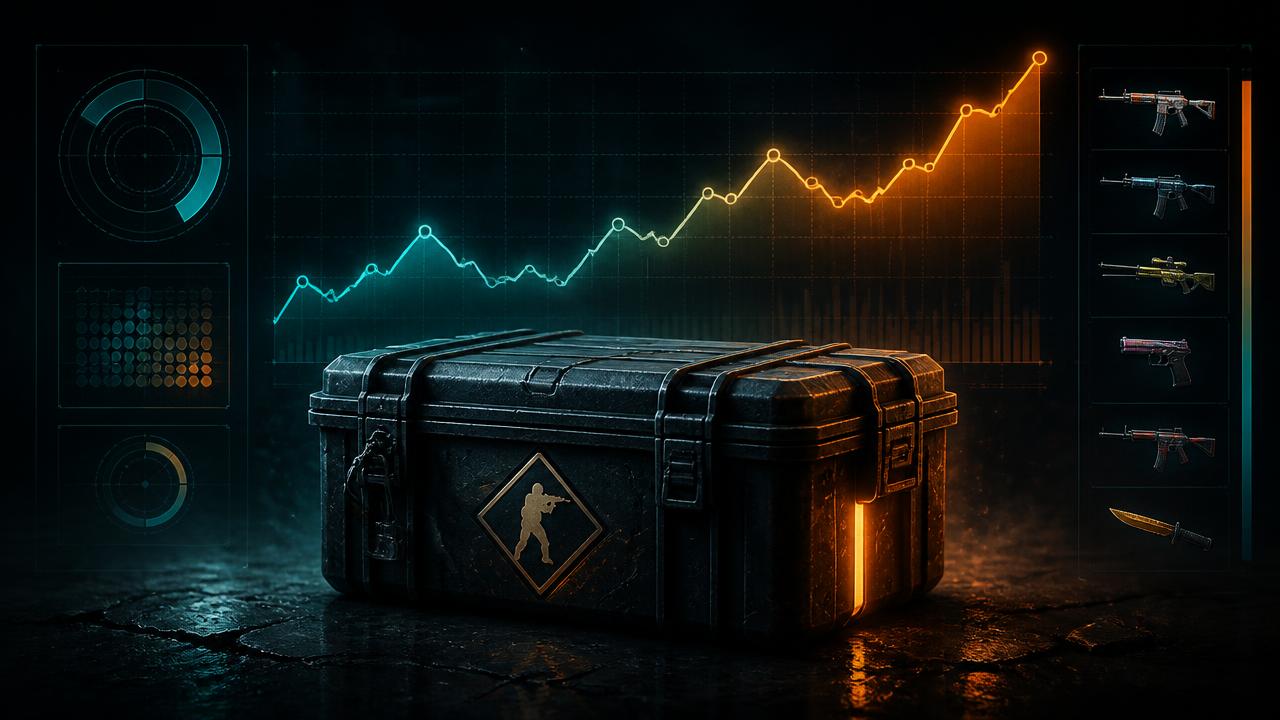

If your bankroll is an inventory rather than a balance, the skin market is not background noise — it is your account value. And through 2026 that value has been drifting down. One of the larger tracked datasets found the median CS2 item worth at least a dollar fell roughly 9% between April and June, with about three items dropping for every one that rose. The market as a whole is still enormous. It is just not going up.

What the Data Shows
Across nine pricing snapshots taken between April 12 and June 29, 2026, covering tens of thousands of item variants on dozens of marketplaces, the median item priced above a dollar and listed on ten or more marketplaces moved about -9.1%. Of the 16,428 items that cleared that bar in both snapshots, 12,132 fell and 4,285 rose. Meanwhile the total CS2 cosmetic economy is still commonly valued in the region of $6-7 billion.
Both things are true at once: an enormous market, and a broad, quiet decline across most of the items inside it. That is a very different environment from the headline-grabbing crash of late 2025, and in some ways a more important one for regular players, because it affects the ordinary $5-50 skins most people actually deposit rather than the million-dollar knives that make the news.
Why This Matters When You Deposit Skins
Gambling sites do not price your skins the way Steam does. They apply their own valuation, usually referenced to third-party market data, and often with a margin baked in. In a falling market, that margin widens in practice: the site is protecting itself against the item being worth less by the time it resells. You feel this as a deposit that credits noticeably below the price you think your skin is worth.
The same effect runs in reverse on withdrawal. When you cash out into skins, you are buying inventory at the site's valuation, in a market where the median item has been drifting down. If you then hold those items for weeks, the decline continues to work against you. Our deposits and withdrawals guide goes through how the valuation step works in detail.
The practical point: in a soft market, a skin bankroll carries two costs — the house edge on whatever you play, and the drift of the items themselves. Cash and crypto balances only carry the first.
What's Pushing Prices Down
Supply is the dominant force. Every case in the active drop pool adds inventory to the market daily, and openings keep converting containers into more circulating skins. Unless demand grows at the same pace, the arithmetic points one way.
Demand, meanwhile, has taken several knocks in 2026. Legal pressure on loot boxes in the United States, the removal of skin-site sponsorship from tier-1 esports, and general caution after the 2025 supply shock have all trimmed speculative buying. Add Steam's structural frictions — a wallet balance cap and roughly 15% in cumulative fees on market sales — and the incentive to hold large inventories weakens further.
Five Practical Adjustments
- Check the credited value before you confirm a skin deposit. If a site is valuing your item well below market, deposit cash or crypto instead.
- Don't leave inventory parked on a site. Platform risk and price drift stack on top of each other.
- Prefer liquid, low-tier items for deposits. Common playskins move less violently than speculative knives and rare patterns.
- Treat skins as spend, not savings. The last twelve months are a reminder that "skins only go up" was never true.
- Set the limit first. A soft market is exactly when chasing looks tempting — our bankroll guide and responsible gambling page cover how to hold a line.
The Bottom Line
Nothing here says stop playing. It says know which currency you are playing in. A falling median item value quietly taxes anyone whose balance is held in skins, on top of every house edge they face. If you are choosing where to play this autumn, the sites that credit deposits fairly and pay out quickly matter more than usual — that is a large part of what our rankings are built to measure.
Market figures cited are from third-party pricing datasets covering April to June 2026 and public market valuations published in September 2026. Prices move constantly; treat all figures as a snapshot, not a current quote.