
Counter-Strike losses are usually talked about like bad beats or funny clips, but some of them are big enough to look more like financial disasters. In the last year alone, CS2 has produced a record case-opening stream that ended deep in the red, a market crash that wiped out billions in paper value, and individual inventories that lost six figures almost overnight. If the expensive-skins article shows how absurd the upside can get, this list shows the other side of the coin.
1) The $650,000 Case-Opening Stream That Still Lost Money
In July 2025, a group of major creators including ohnePixel, Nadeshot, TimTheTatman, HeyZeus, Arrow, and Sparkles took part in what was widely described as the biggest CS2 case opening ever, burning through roughly $650,000 in cases and capsules. The headline-grabbing part is that even after hitting two Katowice 2014 Holo stickers, the event still reportedly ended deep in the red. That makes it one of the clearest and biggest publicly documented "everyone lost" moments in CS2 history.
What makes this story so clickable is the contrast between the spectacle and the outcome. On paper, pulling even one Katowice 2014 Holo is lucky. Pulling two should feel like a miracle. But the total cost was so extreme that even those rare hits were not enough to make the stream profitable. It is one of the best real-world examples of how brutal case-opening math becomes when the stakes get truly ridiculous.
2) A Player Spent Nearly $300,000 Opening Over 118,000 Cases
One of the most shocking recent stories came from a Uruguayan player who shared stats showing he had opened more than 118,000 CS:GO and CS2 cases since 2018. Based on key costs alone, the reported spend was about $295,000, and that figure did not even include the cost of the cases themselves.
That number is wild on its own, but the details made it even uglier. The report said the odds lined up almost perfectly with Valve's expected drop rates, which means this was not some freakishly cursed run. It was more like a giant public reminder that even after opening more than one hundred thousand cases, the system still behaves exactly how the odds say it should. The player's longest drought without a gold was reportedly 2,106 cases, and at the time of publication he was already 829 cases into another dry streak. If you want to understand what provably fair actually means in practice, this is a painfully clean dataset.
3) Trainwreckstv Opened $100,000 in Rare Cases and Got About $6,875 Back
Streamer Trainwreckstv reportedly opened 1,000 rare CS2 cases worth more than $100,000 in total. The result was brutal: the reported value of his notable pulls came to only about $6,875, or roughly 6.8% of the value of the cases. The article highlighted a few decent items, including an M9 Bayonet Fade and a Karambit Forest DDPAT, but nothing close to what would have been needed to justify the spend.
This is one of the cleanest "biggest losses" stories because the numbers are simple and cruel. Spend six figures, get back a tiny fraction, and still have enough visible good pulls for casual viewers to think the opening looked exciting. It is exactly the kind of result that keeps case opening entertaining to watch while still being a financial disaster for the person paying for it. This is why solid bankroll management matters — even for entertainment.
4) Magixx Said He Lost More Than $100,000 in the 2025 Skin Collapse
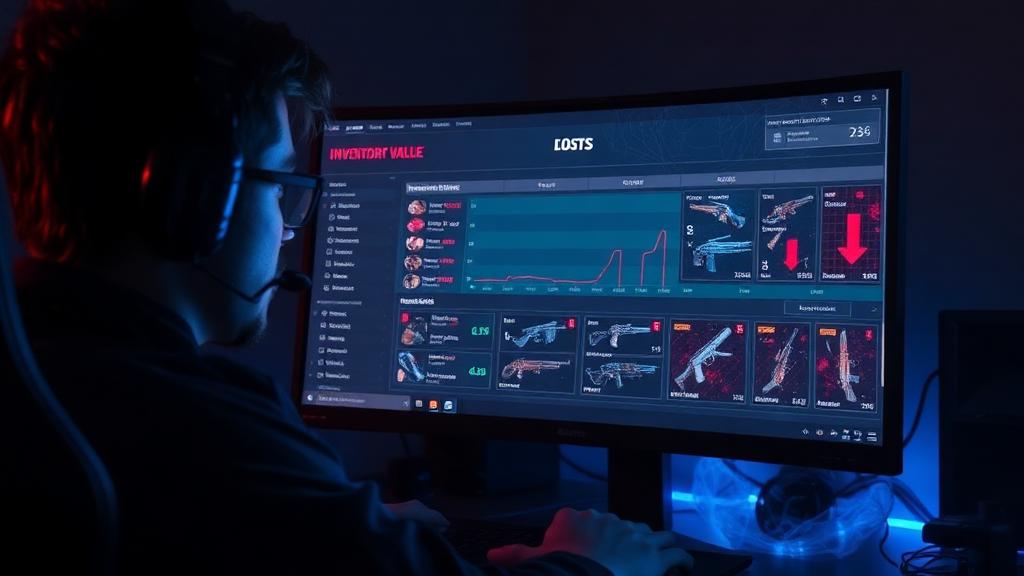
The October 2025 trade-up update did not just hit anonymous collectors. It reportedly hit well-known people in the scene too. According to Escorenews, former Team Spirit player Boris "magixx" Vorobyev said his inventory lost more than $100,000, which he described as roughly half its value. The same report said streamer Evelone lost about $375,000, Aunkere lost about $100,000, and one European trader was said to be down as much as $500,000.
These numbers matter because they turn an abstract market crash into something much more real. When people hear that a skin market lost billions, it sounds distant. When they hear a known player says he got hit for six figures, it lands differently. It also shows how many inventories in CS2 are no longer just hobby collections. For some players and traders, they function more like speculative portfolios that can get wrecked by one update. As we covered in our Q1 2026 skin prices report, the market has since recovered — but the scars from October remain.
5) Valve's Update Reportedly Wiped Out Around $1.8 Billion to $3 Billion Overnight
The biggest loss of all was not tied to one player. It hit the entire market. After Valve's October 2025 update changed how knives and gloves could be obtained through trade-ups, multiple outlets reported that the CS2 skin economy lost around $1.8 billion to nearly $2 billion in market value within a day, while other reports put the panic-drop as high as $3 billion at the worst point. One report cited a fall from about $6.057 billion to $4.272 billion in 24 hours, while another described a plunge from about $6.08 billion to $3.08 billion overnight.
That update instantly changed the value logic of some of the game's most expensive items. Knives and gloves, previously protected by rarity, suddenly looked less scarce. Some collectors and investors got crushed, while other people holding the right Covert skins got unexpectedly rich. It was a reminder that in CS2, your inventory may feel like an asset portfolio, but it still lives inside a game controlled by one developer with the power to rewrite the market in a single patch. For players looking at CS2 gambling sites, the lesson was clear: skin values are never guaranteed.
Why These Losses Hit So Hard
The common thread in all five stories is not just bad luck. It is scale. CS2 losses become especially brutal when randomness, speculation, and illiquidity collide. Cases are mathematically negative-EV over time, which makes massive openings dangerous by design. On the market side, high-end skins can look stable for months or years right up until Valve changes a mechanic and turns "safe" inventories into exposed positions overnight.
That is also why the biggest CS2 losses are so clickable: they do not feel like normal gaming stories. They feel like a cross between gambling losses, stock-market crashes, and flex-culture implosions. One minute someone is showing off a dream inventory. The next minute they are posting screenshots of a six-figure haircut. Understanding how CS2 gambling works helps put all of this in context.
Final Thought
If the expensive-skins list is the fantasy version of Counter-Strike's economy, this is the reality check. Yes, people really do hit monster items and cash out for absurd amounts. But there is a reason the biggest losses are often easier to verify than the biggest wins: losing money in CS2 is incredibly easy, and doing it at scale is almost effortless.
With skin prices continuing to climb in 2026 and the market recovering from last year's crash, the temptation to go big has never been stronger. Whether you are a trader, a gambler, or just someone who likes to watch the market from the sidelines, these losses are worth knowing about — because the next one is probably already happening.